


Brazil is roughly the size of the contiguous United States, so getting around Brazil comes down to one decision: match the vehicle to the distance. Fly when the trip is more than about six hours by road, take a long-distance bus for the shorter hops, and use Uber or 99 for everything inside a city.
That rule covers most itineraries. The rest of this guide is about the details that decide whether it goes smoothly: which airport, which ticket site accepts a foreign card, and where the apps stop working well.
Getting Around Brazil: Which Transport for Which Distance
Brazil has almost no useful passenger rail, so the choice is between planes, buses, boats and cars. The table gives approximate times for common routes. Real times vary with traffic, stops and connections.
| Route | Flight (nonstop) | Bus | Our pick |
|---|---|---|---|
| Rio to São Paulo | About 1 hour | About 6 hours | Either; flight if you use the city-center airports |
| Rio to Paraty | No airport | About 4–5 hours | Bus or private transfer |
| São Paulo to Foz do Iguaçu | About 1.5–2 hours | About 16 hours | Flight |
| Rio to Salvador | About 2 hours | More than 24 hours | Flight |
| São Paulo to Manaus | About 4 hours | No practical road route | Flight |
The Rio–São Paulo pair is the one where the choice is genuinely close. We compare the two cities themselves in Rio de Janeiro vs São Paulo, so here we only cover the transport side.
Domestic Flights: Airlines, Airports and Bag Fees

Three airlines dominate: LATAM has the largest network, Gol is strong on short-haul routes, and Azul reaches smaller cities the other two often skip. On big trunk routes you can usually pick any of them. For secondary destinations, Azul may be the only nonstop option.
Fares on busy routes can be low if you book ahead. Popular São Paulo–Brasília and São Paulo–Salvador flights have been listed at roughly US$50 to $100 one way. Holiday periods such as July, Christmas and Carnival book up fast, so lock in those dates early.
Choose the right airport in Rio and São Paulo
Both cities have two main airports, and the choice changes your day. In Rio, Santos Dumont (SDU) sits by downtown and is a short ride from Copacabana and Ipanema. Gol has a particularly strong presence there. Galeão (GIG) is much farther out and handles most international and long-haul flights. If you are choosing a base, our guide to where to stay in Rio de Janeiro shows how far each neighborhood is from either airport.
São Paulo works the same way. Congonhas (CGH) is close to the city and carries short domestic hops, while Guarulhos (GRU) is a long drive out and handles most international traffic. Check which airport your ticket uses before you book a hotel or a connection. Allow generous transfer time to Guarulhos at rush hour.
Baggage: the fare you pick decides
The cheapest domestic fares usually include only a carry-on, with no checked bag allowance on the cheapest fare across all three airlines. Checked bags are an add-on, and the price depends heavily on when you buy. GOL’s own fee schedule, for example, lists R$50 for a first bag bought through digital channels versus R$100 at the check-in counter on its Light and Promo fares. Fees change, so check the airline’s page before you fly. GOL’s optional service fees page shows the structure.
Do the math before you book. A “cheap” fare plus two bags at the counter can cost more than the next fare up with bags included. Also note that the weight limit is usually 23 kg (51 lbs) per bag, and overweight charges are per kilo. This is stricter than many US international allowances, so repack before you leave your last hotel.
Booking from abroad
The airline websites work in English and take foreign cards. If a site asks for a CPF (the Brazilian taxpayer number), look for the option to enter a passport number instead, or switch to another airline’s site or app. You must show your passport as ID at check-in, so keep it in your hand luggage.
US travelers can often use the same loyalty accounts: United elite status has perks with Azul, American with Gol, and Delta with LATAM. Partner deals change, so confirm before you buy. UK and EU travelers can also search through Oneworld and other alliance programs where LATAM or Azul partners apply.
Long-Distance Buses in Brazil
Brazilian coaches are better than most visitors expect. The seats recline, the air conditioning is strong, and the major routes run frequently. Buses make sense for trips of roughly three to six hours, particularly when you want to go from town center to town center, such as Rio to Paraty or São Paulo to the coast.
Pick a seat class
Most companies sell several classes. Convencional is the basic seat, executivo has more legroom, and semi-leito or leito seats recline almost flat. For overnight trips, the extra cost for leito is worth paying. Bring a sweater, because the air conditioning can be cold.
Buying tickets as a foreigner
This is the main snag. Individual bus company sites often fail for non-Brazilians because they expect a Brazilian card, address and CPF. Aggregators work better. ClickBus accepts international cards and lets foreigners buy with a passport number instead of a CPF. Buser and Busbud are alternatives, and Busbud has an English interface.
Buying at the terminal (the rodoviária) is also an option. It can be the cheapest route because there are no booking surcharges, but some operators ask for a CPF at the counter. Allow time for that and keep your passport handy. For popular routes on holiday weekends, buy online a few days ahead rather than gambling on same-day seats.
On the bus
Keep valuables and your passport with you, not in the overhead rack or the hold. Label your suitcase and keep the baggage tag. At night, arrive at the terminal in daylight if you can, and take a licensed taxi or a rideshare from the terminal door rather than walking. Our honest guide to safety in Brazil covers the broader picture.
Uber, 99 and Taxis Inside Cities

In most Brazilian cities, rideshare is the default for tourists. Uber and 99 both operate widely. You do not need a Brazilian phone number to open an Uber account, so your home-country account should work as soon as you land. 99 is the local rival. It is often a little cheaper on short rides, and it can have more drivers in smaller cities.
Cards are the usual way to pay. Uber, 99, inDrive and Cabify all accept international credit cards, but add your card before you travel and keep a backup app installed. If one app declines your card, the other often works. For notes on cash, cards and fees, see our guide to money in Brazil.
Airport pickups
Airports use designated rideshare zones, and drivers cannot wait at the curb, so request your ride only once you are standing at the pickup point. At Rio’s Galeão, the rules are specific: Uber’s own airport page says you cannot request a taxi pickup there through the Uber app. You can still request a standard Uber car from the designated area. Uber’s Galeão page explains the options.
Ignore people in the arrivals hall who offer a “taxi” or an “Uber”. Men approach tourists at Guarulhos with these offers. Use the app, or the official prepaid taxi counter. Official pre-paid taxi kiosks operate in the arrivals halls at both Guarulhos and Congonhas.
Safety habits for rideshares
- Match the license plate, car model and driver name to the app before you get in.
- Ask “Qual é o seu nome?” or let the driver say yours first. Don’t offer your name.
- Wait inside a shop or hotel lobby while the car approaches, not on a dark curb.
- Sit in the back and keep your phone away from the open window in busy areas.
For night-time rides and neighborhood-level advice in Rio, see our Rio safety guide.
When a regular taxi is better
In São Paulo at rush hour, a licensed taxi can use bus lanes that private cars cannot. 99 offers a taxi option in its app, which helps on those lanes. That can turn a slow airport run into a faster one. Outside rush hour, the apps are usually simpler and cheaper.
Metro and City Buses
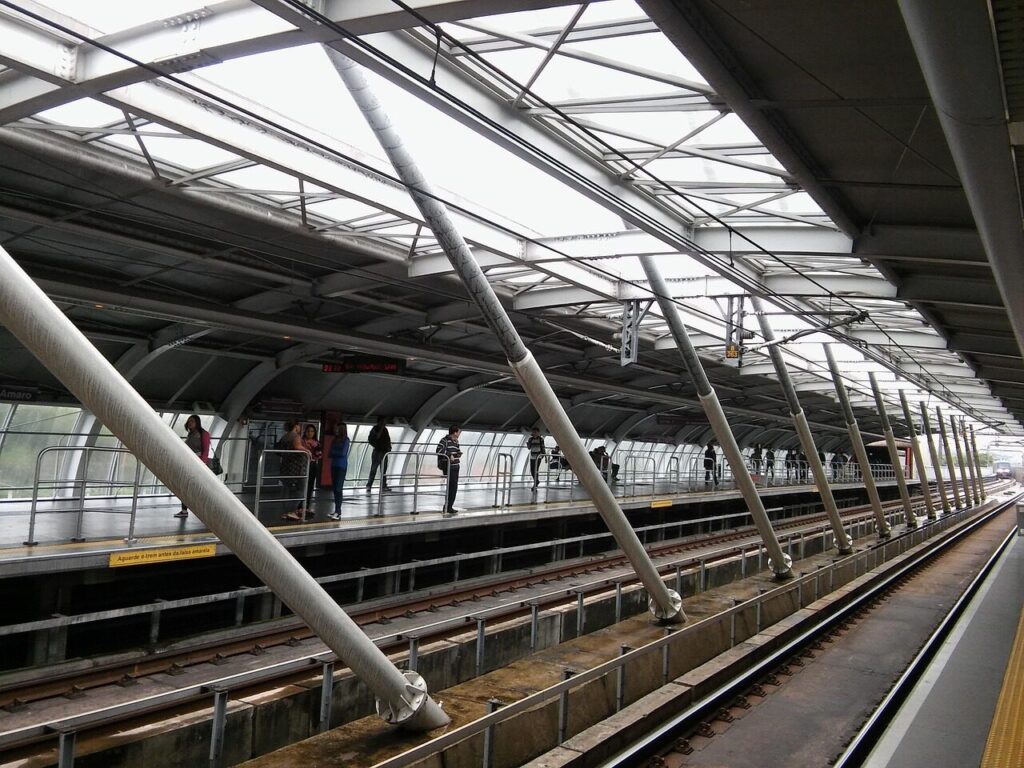
The metro in São Paulo and Rio is clean, safe by day and quick for crossing town. São Paulo’s network reaches many museums, parks and the main rodoviária. Rio’s metro links Zona Sul with downtown and is a good alternative to a taxi at rush hour. Avoid it late at night, and mind your phone and bag on crowded cars.
City buses are cheap but harder for a first-time visitor. Some cities no longer accept cash on board, so a rechargeable transit card is worth getting soon after you arrive. Routes are shown by number and destination in Portuguese, so use Google Maps or Moovit for directions. If you want to practice a few useful phrases first, see our Brazilian Portuguese phrases guide.
Boats and Ferries, Including the Amazon

Boats are part of normal transport in several regions. In Rio, ferries cross the bay to Niterói. Ilha Grande is reached by ferry from the mainland. In Salvador, ferries and catamarans cross the bay to Itaparica and beyond. These are inexpensive and usually sell tickets at the terminal.
The Amazon is different. There is no practical road link between Manaus and the rest of Brazil’s tourist circuit, so most visitors fly in. Boats connect river towns, and Manaus–Belém river trips take several days in hammock or cabin class. For a short visit, most travelers choose a lodge or organized river trip instead. Start with our Manaus travel guide for the gateway city.
Renting a Car
A rental car rarely helps in Rio, São Paulo or Salvador, where traffic, parking and street safety are all difficult. It can make sense for a coastal road trip, a wine-country loop in the south or a stay in a region with limited public transport. Brazilians drive on the right, as in the US and EU.
Licenses are where nationality matters. US, UK and EU licenses are generally accepted for short tourist stays, but rental companies set their own rules, so check your rental contract. An International Driving Permit costs little and removes doubt. US drivers can get one through AAA or AATA, and UK drivers from the Post Office. Expect tolls on main highways and carry a little cash or confirm how your rental company handles electronic tags.
Avoid night driving on rural highways. Potholes, animals and unlit trucks make it riskier than daytime.
Planning Your Visit
Book the long flights first and the buses later. Airfares rise as dates approach, while bus seats are usually easy to find a few days ahead outside holiday weeks. Install Uber, 99 and one bus site before you leave home, and add a payment card to each.
Data matters more than you might expect, because you will use maps and ride apps all day. US carriers’ international plans, UK providers and EU roaming deals differ, and EU roaming does not apply in Brazil. An eSIM bought before you land is often the simplest fix for all three groups.
If you are still shaping the route, our two-week Brazil itinerary shows how the flights and transfers fit together. For Iguazu, the Foz do Iguaçu travel guide covers the airport and the city.
Frequently Asked Questions
Do I need a CPF to buy transport tickets in Brazil?
Usually not. Major airline websites take foreign cards, and you can often enter a passport number if a form asks for ID. ClickBus lets foreigners buy bus tickets with a passport number. Some terminal counters and individual bus company websites may still ask for a CPF, so use an aggregator when you can.
Does my home Uber account work in Brazil?
Yes. You can open or use an Uber account without a Brazilian phone number, and your existing account usually works as soon as you land. Add a payment card before you travel, and install 99 as a backup. If one app declines your card or has no drivers nearby, the other often works.
Is it safe to take an overnight bus in Brazil?
Major routes on reputable companies are generally fine, and many Brazilians use them regularly. Choose a leito or semi-leito seat for sleep, keep your passport and valuables on your lap, and arrive at the destination terminal in daylight if possible. Take a licensed taxi or rideshare from the terminal rather than walking.
Can I use my US, UK or EU driver’s license in Brazil?
Generally yes for short tourist stays, but the rental company sets its own conditions. Carry your home license and an International Driving Permit to avoid disputes at the counter. US drivers can get a permit from AAA or AATA, and UK drivers from the Post Office. EU travelers should ask their national motoring club.
Can I travel around Brazil by train?
Not in any practical way. Brazil has no national passenger rail network comparable to Europe’s. A few scenic or tourist trains operate on short routes, but they are excursions rather than transport between cities. For distance, use flights and buses, and plan on rideshares or metros for city travel.