
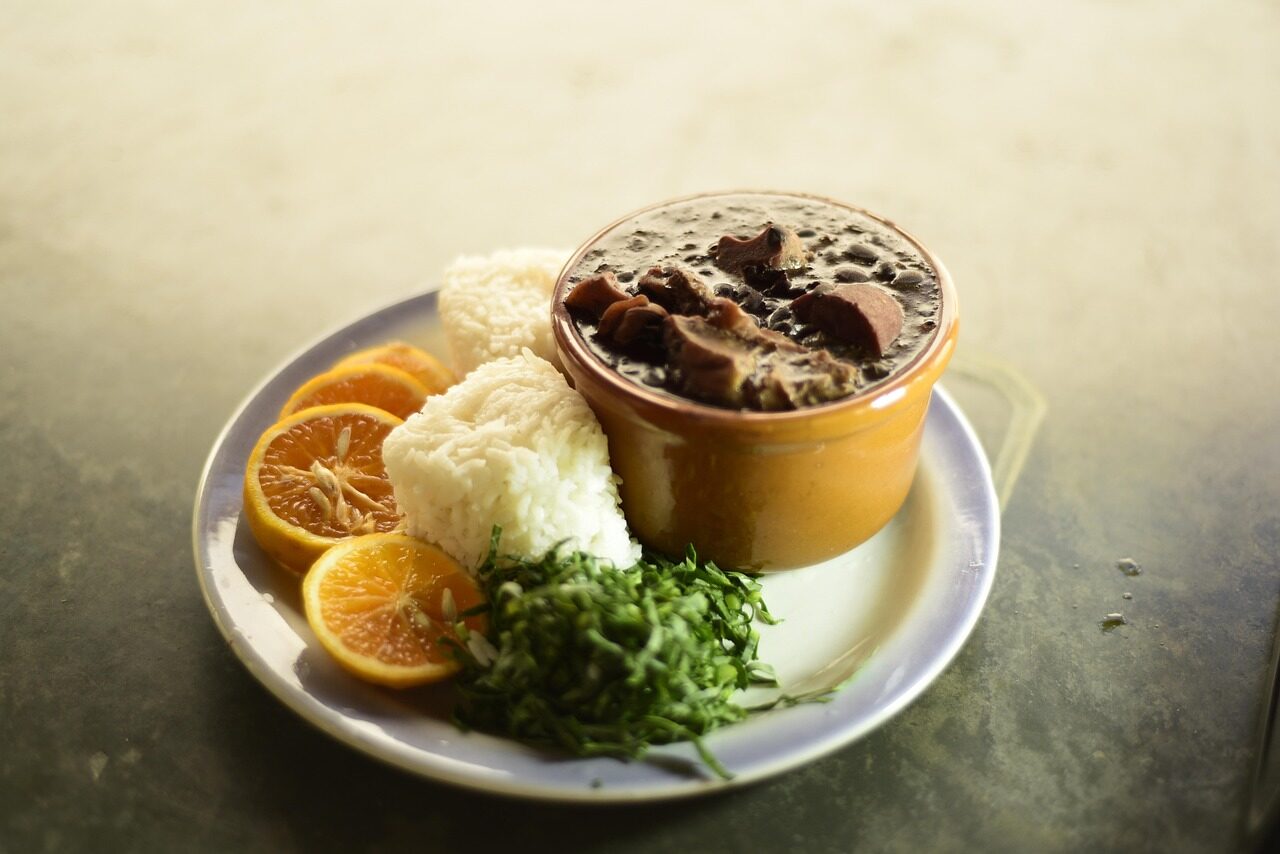

Feijoada is a slow-cooked stew of black beans and pork, and it is the dish most Brazilians will name first when asked for a national plate. It arrives with white rice, garlic-sautéed collard greens, toasted cassava flour and orange slices, and it is traditionally a long Saturday lunch rather than a quick bite.
If you only eat it once, do it at a proper restaurant on a weekend afternoon, with company and no plans for the next few hours. This guide covers what is in the pot, where the dish really comes from, how it is served, where to find a good one, how to order, and how to make a decent version at home. For the wider picture of what to eat in the country, see our guide to traditional Brazilian food.
What Goes Into Feijoada
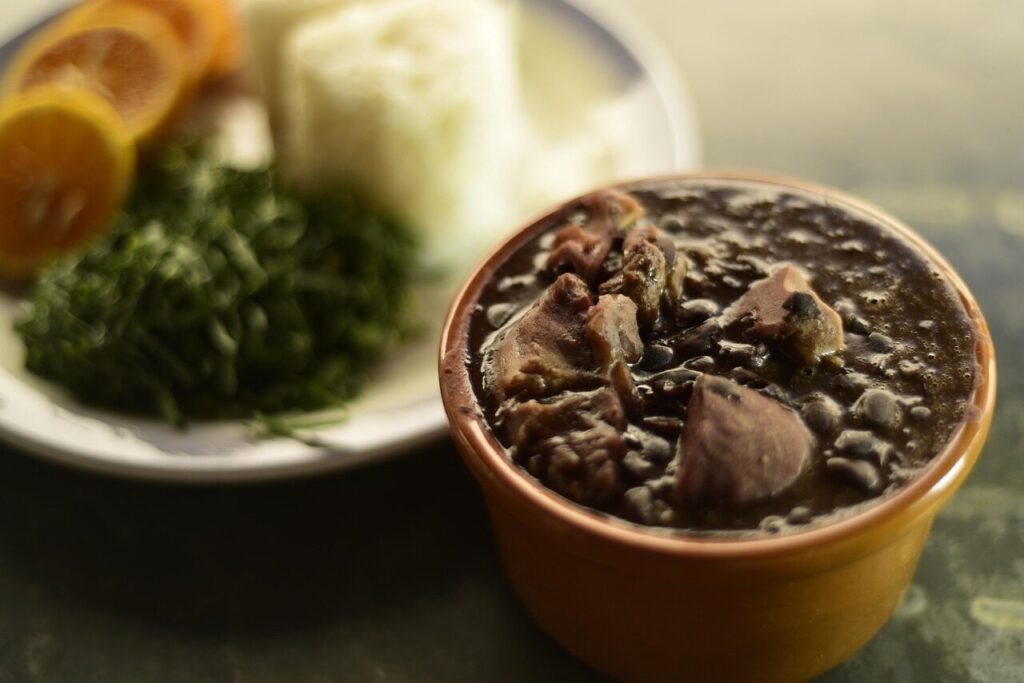
The base is black beans (feijão preto), cooked until the broth turns dark, thick and glossy. The beans simmer with a mix of cured, smoked and fresh pork, plus salt-dried beef. The more varied the meat, the richer the pot.
A typical restaurant version includes some combination of these:
- Carne seca: salted, air-dried beef that has to be soaked and rinsed before cooking. It adds a deep, savory edge.
- Linguiça: a thick pork sausage, often smoked, usually sliced into rounds.
- Paio: a cured, smoky sausage, leaner and firmer than linguiça.
- Bacon and pork belly: the main source of fat and flavor.
- Pork ribs: cooked until they fall off the bone.
- Trotters, ears and tail: the traditional “humble” cuts, which give the broth body. Many modern kitchens leave them out or serve them separately.
Onion, garlic and bay leaf season the beans, and some cooks add a little pepper. Feijoada is not spicy by default. Heat comes from a bottled or house-made pepper sauce that sits on the table.
The cooking is slow for a reason. Cured meats need soaking overnight, the beans need hours on the stove, and many cooks make it a day ahead because it tastes better reheated. That is also why restaurants tend to schedule it rather than offering it every day.
The Origin Story, and What Historians Say
The version most visitors hear is that feijoada was invented by enslaved people on colonial plantations, who supposedly made a stew from the pig parts their owners discarded. It is a powerful story and it is repeated everywhere, including by guides and menus.
Many food historians consider it an oversimplification. Bean-and-meat stews were already well established in Portugal, and the Portuguese brought that cooking tradition to Brazil. Enslaved cooks certainly shaped how colonial kitchens worked, and African and Indigenous ingredients and techniques left their mark on Brazilian food. But there is little solid evidence that feijoada began as a single slave-quarters invention, and colonial households ate prime cuts of pork too.
What is clear is that the dish took its modern form in Brazilian cities. By the nineteenth century, versions were being served in places like Rio de Janeiro, and over time it became a shared national dish that crossed class lines. A safe way to put it: feijoada is a Portuguese stew tradition reworked in Brazil with local beans, local sides and a social ritual all its own.
How Feijoada Is Served
The beans are never eaten alone. Feijoada is a plate with a set cast of companions, and each has a job: something starchy, something green, something crunchy, something sharp.
| Accompaniment | What it is | Why it is there |
|---|---|---|
| White rice | Plain, fluffy rice | Soaks up the broth and balances the richness |
| Couve | Collard greens, sliced very thin and quickly sautéed with garlic | Bitter freshness against the fat |
| Farofa | Toasted cassava flour, often with butter, bacon or egg | Dry crunch and a nutty flavor you sprinkle on top |
| Laranja | Peeled orange slices | Acidity and sweetness; traditionally said to help digestion |
| Vinagrete | Chopped tomato, onion and pepper in vinegar | Sharp, juicy contrast |
| Torresmo | Fried pork rind | Extra crunch, where offered |
In traditional restaurants the beans and the meats often arrive in separate pots or on a separate platter. You build your plate yourself: beans and broth first, then a few pieces of meat, then rice, greens and farofa around the edges. Spoon some farofa over the beans if you like the texture, and squeeze a little orange between bites.
The dish is often called feijoada completa, meaning the full spread with all the sides. If a menu lists it that way, expect the works.
When and Where to Eat Feijoada in Brazil
Saturday lunch is the classic slot. Many restaurants serve feijoada only on Saturdays, some add Wednesdays (a long-standing custom, especially in Rio), and a few offer it every day. On Sundays, families often cook it at home or go out for a late, slow meal.
It is a lunch dish, and a late one. Think early afternoon through to around 4 p.m., not an evening dinner. Because it is so filling, locals plan nothing strenuous afterward.
Rio de Janeiro
Rio is the city most associated with feijoada, and you will find it in neighborhood botecos, old-school restaurants and some hotel dining rooms. Santa Teresa, the hilltop neighborhood with its tram and winding streets, is a popular area for a Saturday feijoada lunch. Some samba schools and music venues also host feijoada afternoons with live samba, which is a good way to combine the meal with a bit of local culture. If you are planning around the city’s biggest party, our Rio Carnival guide explains how that scene works. For the rest of your time there, start with the Rio de Janeiro travel guide.
São Paulo
São Paulo takes feijoada seriously too, with everything from long-running family restaurants to modern kitchens that rework the plate with lighter broth or premium cuts. Saturday lunch tables fill early, and the city’s size means you can compare very traditional and very contemporary versions. Our São Paulo travel guide will help you pick a base neighborhood, and if you are weighing both cities, Rio vs São Paulo covers the differences.
Elsewhere in Brazil
Feijoada appears on menus in nearly every Brazilian city, but it is not the signature dish everywhere. In Salvador, for example, the food identity centers on dendê oil, seafood and street snacks, and feijoada is more an option than a specialty. Our Salvador da Bahia travel guide explains what to prioritize there. In general, the closer you are to Rio, São Paulo and the Southeast, the more likely feijoada is the Saturday star.
How to Order Feijoada and What to Expect
Restaurants serve feijoada in a few different formats, and knowing which one you are looking at saves confusion.
- Buffet (self-service): common on weekends. You see everything before you take it, which is useful for skipping the ears and trotters. Some buffets charge a fixed price per person, others by weight.
- Table service, shared pot: the whole feijoada arrives for the table, with sides, and you serve yourselves. Good for groups.
- Individual portion: a single bowl or plate with beans, a few meats and the sides. Often the easiest choice for solo travelers.
If a portion is described as serving two, take that seriously. Feijoada is dense, and a pot meant for two can be generous.
Useful phrases
Staff in tourist areas often speak some English, but a few Portuguese phrases help at traditional places:
- Uma feijoada para dois, por favor. One feijoada for two, please.
- Sem orelha e sem pé, por favor. Without ear and trotter, please.
- Tem feijoada light? Is there a lighter version? Some places make one with fewer fatty cuts.
- Pode trazer molho de pimenta? Could you bring pepper sauce?
What to drink
The classic partner is a caipirinha, made with cachaça, lime and sugar, or a very cold beer. Both cut through the fat. Plenty of people choose soda, juice or water instead, which is completely normal. Coffee, served small and strong, usually closes the meal.
Pace yourself. The caipirinha is stronger than it tastes, and a heavy stew plus alcohol plus afternoon heat is a quick route to a nap.
Regional and Dietary Variations of Feijoada
There is no single official recipe. The version you get depends on where you are and who is cooking.
| Style | Typical differences |
|---|---|
| Rio and Southeast | Black beans, a mix of cured and fresh pork, carne seca, with the full set of sides |
| Parts of the Northeast and elsewhere | Other bean types, such as brown beans, and different meat mixes; side dishes may vary |
| Portuguese-style feijoada | Often white or red beans, cabbage and chouriço; not the same dish as the Brazilian one |
| Modern or “light” versions | Leaner cuts, less fat, sometimes served in a small bowl as a starter |
| Vegetarian | Black beans with smoked vegetables, mushrooms or plant-based sausage |
Do not assume a regional variant is “wrong.” Brazilians have strong opinions, but the dish has always moved with local ingredients.
Dietary considerations
Traditional feijoada is pork-heavy, so it is not suitable if you avoid pork for religious or personal reasons, and halal or kosher options are rare. Vegetarian and vegan feijoada does exist, particularly in larger cities, but you should ask directly, since even a vegetable-looking pot may be cooked with bacon or meat stock. The beans themselves are naturally gluten-free, but sausages and sauces vary, so people with celiac disease or serious allergies should check with the kitchen. Farofa is made from cassava, not wheat, although some versions are mixed with other ingredients.
How to Make Feijoada at Home
A home version does not need to be authentic in every detail to be good. It needs time and a mix of meats. Here is a straightforward outline without fixed quantities, since you can scale it to your pot and your guests.
- Soak the beans and the cured meats. Cover dried black beans with water overnight. Soak salted beef in cold water too, changing the water a few times, to remove excess salt.
- Start the meats. Simmer the salted beef and any trotters or ribs first, since they take longest. Skim any foam.
- Add the beans. Drain the soaked beans, add them to the pot with fresh water and a bay leaf, and cook gently until they begin to soften.
- Add sausages and bacon. Put in the smoked sausage, bacon or pork belly for the final stretch so they do not disintegrate.
- Build the base. Fry onion and garlic in a little fat, add a ladle of beans to the pan, mash them, and stir the mixture back into the pot to thicken the broth.
- Rest it. Let it sit off the heat, or refrigerate and reheat the next day. Taste for salt only at the end, because the meats contribute plenty.
Outside Brazil, black beans are easy to find. For the cured beef, look in Brazilian or Latin American grocery stores, or use another salted or dried beef. Smoked sausages such as a Portuguese or Spanish-style pork sausage are a reasonable stand-in for linguiça and paio. Collard greens or kale work for the couve. Slice them as thin as you can and cook them for only a minute or two with garlic.
Planning Your Visit
Treat the feijoada as the main event of that day. Book or arrive early for a Saturday lunch in Rio or São Paulo, especially at popular restaurants, and do not schedule a hike, a cable car queue or a long drive right after. A museum or a slow walk, or a rest at your hotel, fits much better.
Think about your timing in the year as well. Feijoada is eaten in every season, but a hearty stew feels most natural in the cooler months of the Southeast. Our month-by-month guide to the best time to visit Brazil shows how the weather varies by region.
If you hope to carry some home, rules differ by destination. Travelers returning to the EU or the UK generally cannot bring meat or dairy products from outside those regions in their luggage, and that includes cured sausages and dried beef. US travelers face restrictions from customs and agriculture authorities on many pork and meat products. Check the current rules with your own customs agency before you pack anything. Safe souvenirs are dry goods such as packaged farofa, cassava flour or a bag of dried black beans, but even these may need to be declared, so check them too.
Finally, keep your expectations flexible. A feijoada can be rustic or refined, smoky or mild, greasy or lean, and it is worth trying more than one style if your itinerary allows it.
Frequently Asked Questions
What is feijoada made of?
Feijoada is a stew of black beans cooked with several kinds of pork, such as sausage, bacon and ribs, plus salted dried beef. Traditional versions may also include trotters, ears and tail. It is served with rice, sautéed collard greens, farofa and orange slices.
Is feijoada spicy?
Not usually. The stew itself is savory and smoky rather than hot. Heat comes from pepper sauce, which restaurants normally bring to the table separately, so you can add as much or as little as you like.
Can vegetarians eat feijoada in Brazil?
Vegetarian feijoada exists, mainly in larger cities, but the standard dish is pork-based. Ask whether the beans are cooked with bacon or meat stock, even if no meat is visible. Saying “feijoada vegetariana” at the start of the order helps avoid misunderstandings.
Why is feijoada served on Saturdays?
It takes hours to cook, it is heavy, and it suits a long, relaxed meal, so weekend lunch became the tradition. Many restaurants serve it only on Saturdays, some also on Wednesdays, and a few every day. Check opening days before you go.
Is feijoada the same as the Portuguese dish?
No. Portuguese feijoada is a related bean-and-meat stew, but it often uses white or red beans, cabbage and chouriço. The Brazilian version centers on black beans and comes with its own set of sides, especially farofa, greens and orange.
How much feijoada should I order?
One individual portion is usually enough for a full meal, since the dish is dense. If a pot is described as serving two, it can feed two hungry people comfortably. At a buffet, start with a modest plate and go back if you want more.